Argentine Tango Lessons in Sacramento
Improvised, close-embraced and led by the walk
Argentine Tango lessons in West Sacramento: no group class is on the schedule right now. Ask us about lessons with an instructor.
- 4/4 time
- 60–70 beats a minute
- travels around the room
Arrow keys or a swipe move to the next dance.
About Argentine Tango
Dance Vision presents Argentine tango as an improvised social dance shaped in Buenos Aires over the last century, about the connection between the leading and the following partner rather than a set sequence of steps.[13]
It calls the dance dramatic and demanding, with pronounced leg and foot action, danced to slower music than some other tangos, while couples travel counter-clockwise around the floor.[13]
How Dance Vision describes Argentine Tango, summarised in our own words. Dance Vision’s own article: The Difference Between American and International Style Ballroom Dance (opens in a new tab)
Feel the count
The music is in 4/4, and dancers walk on the strong beats, 1 and 3, of each bar: this strip shows those two steps, so its tempo is the walking beat. Beginner classes teach an eight-step basic.[7][3]
- 1
- 3
Time signature 4/4. Walking-beat tempo of a medium tango: about 60–70 beats a minute[8]. The slider runs from a slow practice speed (60% of the low end of that range, a way to learn a new pattern, not a rule) up to the fastest. The click sounds only after you press play.
- Richard Powers’ DJ guide gives 62 beats a minute as the sweet spot for Argentine tango.[9]
- Tangology 101 gives two example recordings, about 56 and about 67 beats a minute, and says the walking beat sets the pace.[10]
- NDCA publishes no approved tempo for Argentine tango; it names the dance only as an optional extra.[2]
Upcoming Argentine Tango classes
From the studio schedule, in Pacific time. Confirm a class with the studio before you come.
No class scheduled for this dance right now.
Private lessons are always an option: a free half-hour introductory lesson is a good place to start.
Songs to practice to
- La Cumparsita Gerardo Matos Rodríguez (composer; many recordings)[11]
- Por una Cabeza Carlos Gardel[12]
- Bahía Blanca Carlos Di Sarli · 56 bpm[10]
- Pensalo Bien Juan D’Arienzo · 67 bpm[10]
- La Yumba Osvaldo Pugliese[7]
Titles only, taken from dance-music lists that teachers and DJs have matched to this dance. Use the slider above to hear the tempo first.
Where it comes from
It emerged at the end of the 19th century in Buenos Aires from urban folk dances of the poorer neighborhoods that mixed Spanish, Criollo and African elements.[15]
It grew among immigrant populations arriving in Argentina. Ingredients named include polka, waltz, mazurka, the Cuban habanera and African candombe rhythms.[16]
It reached Europe and the United States in the first decades of the 1900s and evolved into ballroom tango. Its Golden Age was the early 1940s, and a worldwide revival began in the 1980s.[15]
Where it appears: Social tango, danced at milongas · NDCA optional additional American-style dance[1][2]
Where people dance it
It is danced socially at milongas, the tango dance events, with improvisation in an embrace that ranges from close to open. La Cumparsita is traditionally the last song of the last set.[1][11]
NDCA names Argentine Tango, Argentine Vals and Milonga as optional dances that competition organizers may offer in American style.[2]
Argentine and ballroom tango
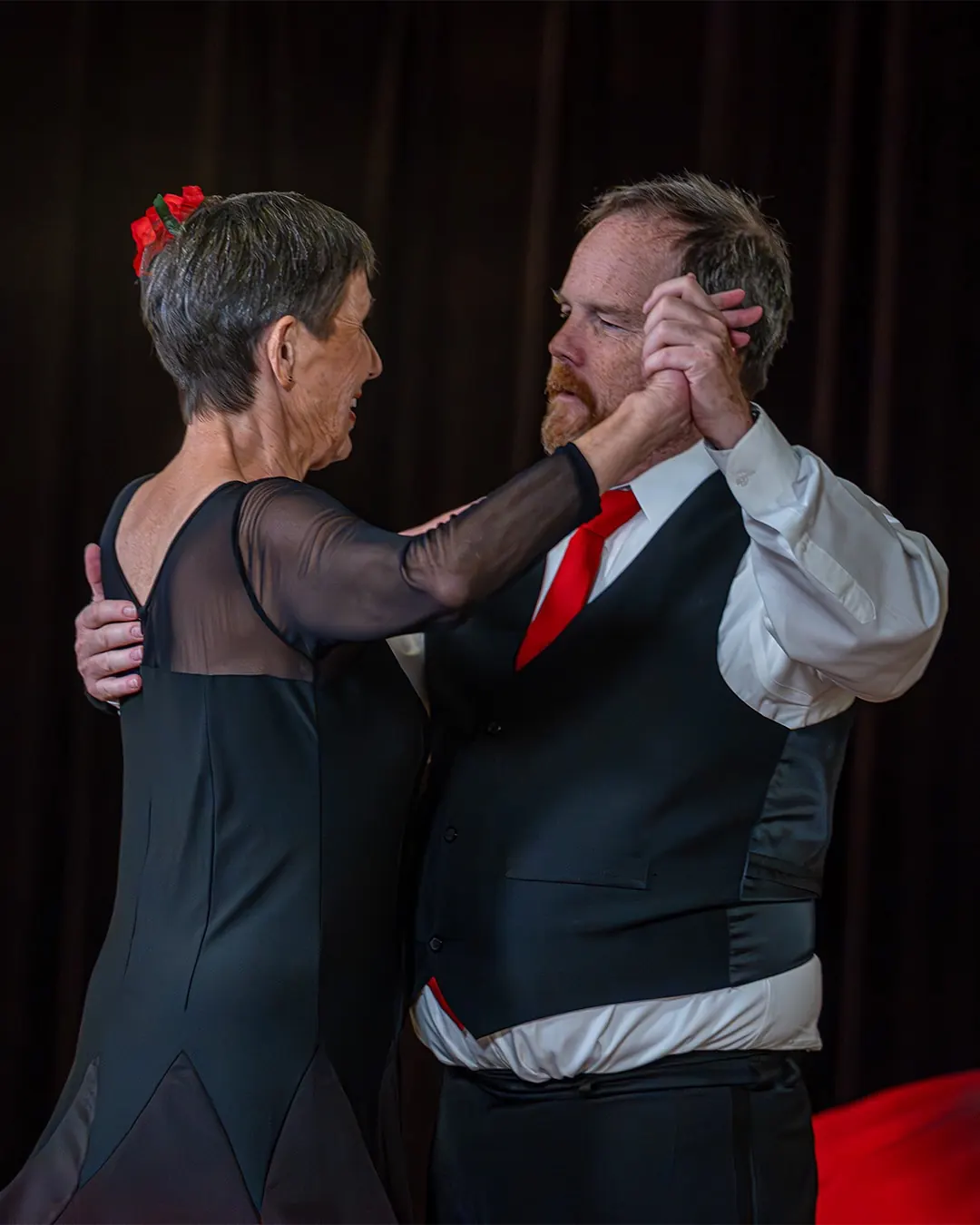
Argentine tango is danced in a close embrace with heads together and is improvised. American tango uses an open embrace with the follower leaning back in profile, and a codified set of figures.[3]
Argentine steps are smooth, gliding eight-count steps, American tango is built on quick-quick-slow patterns, and International tango uses long, sharp strides.[4]
Argentine tango music comes in three rhythms: tango (4/4), vals (3/4) and milonga (2/4 with a habanera-like accent). One source puts a typical repertoire at about 80 percent tango and 10 percent each of vals and milonga.[5]
Most tango steps can be adapted to vals and milonga by changing the rhythm and style of the steps to suit the music.[6]
Sources for this page (18)
- Argentine tango - Wikipedia (background only) (opens in a new tab) Read 2026-09-23.
- NDCA Rules & Regulations, January 2026 v2 Edition (National Dance Council of America) (opens in a new tab) Read 2026-09-23.
- What is Tango? What are the differences between Argentine and American Tango? - Duet Dance Studio Chicago (opens in a new tab) Read 2026-09-23.
- Argentine Tango versus Ballroom Tango - Ultimate Tango School of Dance (opens in a new tab) Read 2026-09-23.
- Rhythms or 'Genres' in tango (2) - Adam Tully (opens in a new tab) Read 2026-09-23.
- Vals & Milonga - Argentine Tango South East (opens in a new tab) Read 2026-09-23.
- Tangology 101 - The Structure of Argentine Tango, Part 2: Rhythm, Melody and Phrases (opens in a new tab) Read 2026-09-23.
- Argentine Tango Music - Tango Bohemia (opens in a new tab) Read 2026-09-23.
- How to Be a Better Dance DJ (Richard Powers, Stanford Social Dance) (opens in a new tab) Read 2026-09-23.
- Tangology 101 - The Structure of Argentine Tango, Part 1: The Basic Structure (opens in a new tab) Read 2026-09-23.
- All You Have To Know About La Cumparsita - the most famous Argentine tango - Ultimate Tango School of Dance (opens in a new tab) Read 2026-09-23.
- Por una cabeza - Wikipedia (background only) (opens in a new tab) Read 2026-09-23.
- The Difference Between American and International Style Ballroom Dance (Dance Vision blog) (opens in a new tab) Read 2026-09-23.
- Ronda (tango) (Wikipedia) (opens in a new tab) Read 2026-09-23.
- A Short History Of Argentine Tango - Tango.ORG (opens in a new tab) Read 2026-09-23.
- The origins of Argentine tango - Tanguito, Argentine Tango Academy (opens in a new tab) Read 2026-09-23.
- DVIDA Directory | Dance Vision (opens in a new tab) Read 2026-09-23.
- Dance Vision home page (opens in a new tab) Read 2026-09-23.
Everything on this page is paraphrased from these sources, each read on September 23, 2026; nothing is copied.