Viennese Waltz Lessons in Sacramento
The fastest waltz: constant turning, right then left
Viennese Waltz classes in West Sacramento: Level 3-5 Ballroom/Latin Technique, Mondays at 7:15 pm, which works on Viennese Waltz among other dances. Private Viennese Waltz lessons with an instructor are available too.
- 3/4 time
- 174–180 beats a minute
- turns in a circle
Arrow keys or a swipe move to the next dance.
About Viennese Waltz
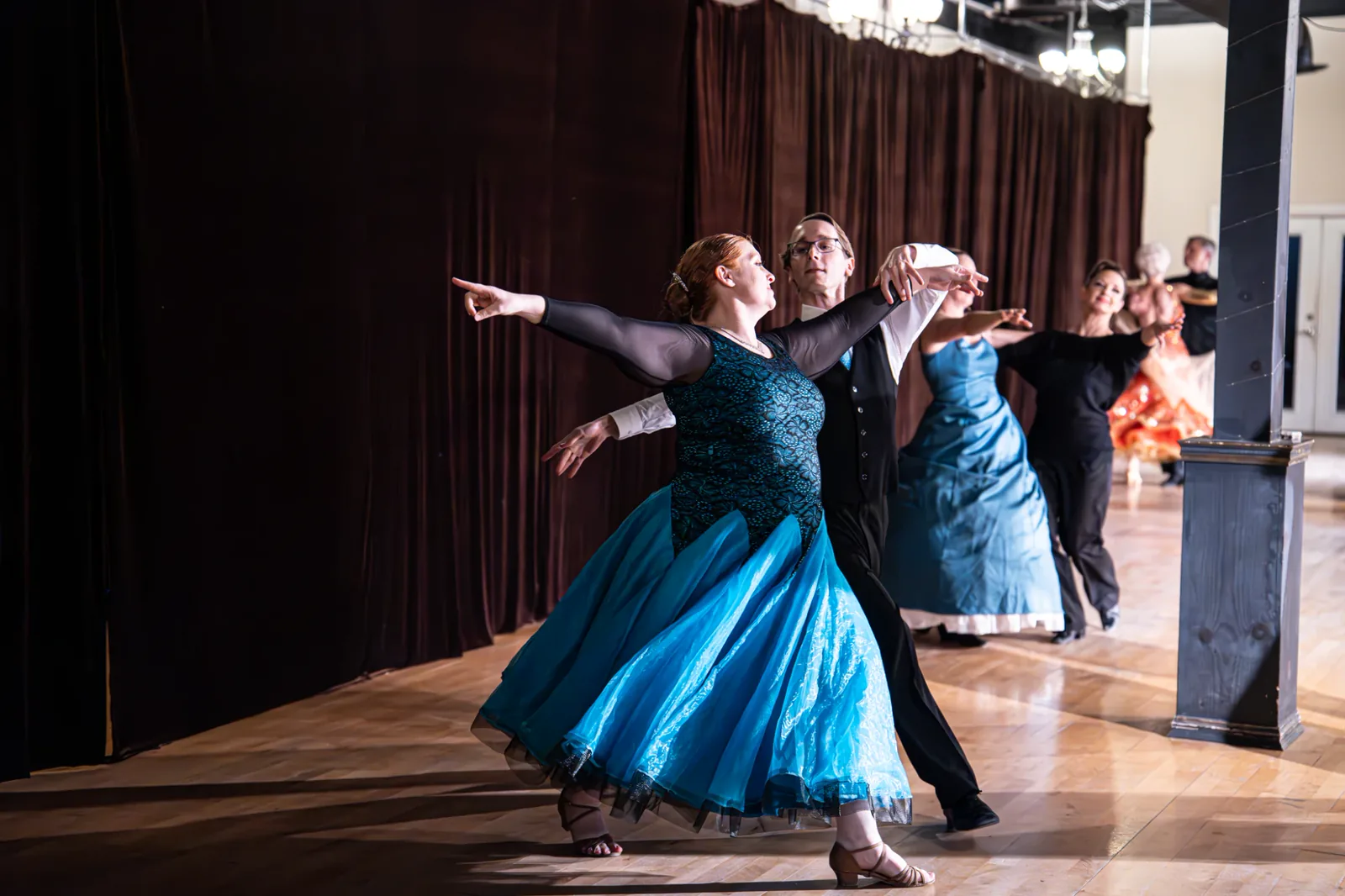
Dance Vision places the Viennese waltz in Vienna and describes it as a much faster relative of the waltz, which is why the slower dance is sometimes called the slow waltz. The feet stay on the floor for a smooth, gliding look, and the movement is full and sweeping, as if racing around the room.[3]
Underneath is the same box action as the slower waltz, turned as it travels, with partners stepping in mirrored directions at a far higher speed.[3]
How Dance Vision describes Viennese Waltz, summarised in our own words. Dance Vision’s own article: How to Dance Viennese Waltz (opens in a new tab)
Feel the count
Like the waltz it is three counts to the bar: 1 2 3. Some teachers count by phrase (123, 223, 323, 423) to keep track of the turns.[3]
- 1
- 2
- 3
Time signature 3/4. WDSF competition tempo, Standard (2018 rules): 58–60 bars a minute (about 174–180 beats a minute)[4]. The slider runs from a slow practice speed (60% of the low end of that range, a way to learn a new pattern, not a rule) up to the fastest. The click sounds only after you press play.
Upcoming Viennese Waltz classes
From the studio schedule, in Pacific time. Confirm a class with the studio before you come.
No class scheduled for this dance right now.
Private lessons are always an option: a free half-hour introductory lesson is a good place to start.
Also covered in
General classes that include Viennese Waltz among their dances. Each week can cover a different dance, so ask the studio which week is Viennese Waltz.
- Today7:15 pmSpotlight Ballroom
Level 3-5 Ballroom/Latin Technique
Christina
Mondays · then Oct 19, Oct 26, Nov 2 and 4 more
Songs to practice to
- The Blue Danube Alfred Hause Orchestra[6]
- Que Sera, Sera Doris Day[6]
- At Last Etta James[6]
- Piano Man Billy Joel[6]
Titles only, taken from dance-music lists that teachers and DJs have matched to this dance. Use the slider above to hear the tempo first.
Where it comes from
It developed out of the Ländler at the end of the 18th century and pushed the minuet off the dance floor in Vienna.[7]
Its exact roots are still debated: research now treats the Ländler as a sibling of the waltz rather than a direct ancestor, and the waltz began its wide social spread around the Congress of Vienna in 1814 and 1815.[5]
First danced at court events and private balls in Vienna, it took its Viennese character from composers such as Joseph Lanner and Johann Strauss I. Early waltzes were quick, with constant turning that could cause collisions; by the mid-19th century couples glided in circles.[7]
Where it appears: International Standard · American Smooth[1][2]
Where people dance it
Vienna’s ball season has up to 450 balls.[5]
Viennese waltz is part of the International Standard division, NDCA lists it in both International Ballroom and American Smooth, and the ISTD examines it as one of five Modern Ballroom dances.[1][2][8]
International and American versions
International Viennese waltz is danced in closed position with a short list of figures (natural and reverse turns, changes, fleckerls, contra check and left whisk). American style allows far more freedom in positions and figures.[1]
NDCA lists 58 bars a minute for International Viennese waltz and 53 for American Smooth.[2]
Sources for this page (10)
- Viennese waltz - Wikipedia (background only) (opens in a new tab) Read 2026-09-23.
- NDCA Rules & Regulations, January 2025 edition, section IX 'Dances and Tempi', B. Approved Tempi (International Style Ballroom and American Style Smooth) (opens in a new tab) Read 2026-09-23.
- How to Dance Viennese Waltz - Dance Vision (opens in a new tab) Read 2026-09-23.
- WDSF Competition Rules (status: June 17, 2018 WDSF AGM, updated 01.09.2018), Rule E.3.2 tempi table and Rule M.1 Smooth Dance table (opens in a new tab) Read 2026-09-23.
- 11 facts about the Viennese Waltz - Berliner Philharmoniker (opens in a new tab) Read 2026-09-23.
- Viennese Waltz - The music of Dancesport (George Pytlik, DanceSportMusic archive) (opens in a new tab) Read 2026-09-23.
- The Viennese waltz - Die Welt der Habsburger (habsburger.net) (opens in a new tab) Read 2026-09-23.
- ISTD Syllabus Outline of Modern Ballroom, Dance Faculty Qualifications, September 2024 ('Dances and Tempi' page) (opens in a new tab) Read 2026-09-23.
- DVIDA Directory | Dance Vision (opens in a new tab) Read 2026-09-23.
- Dance Vision home page (opens in a new tab) Read 2026-09-23.
Everything on this page is paraphrased from these sources, each read on September 23, 2026; nothing is copied.